Athletic Recovery &
Mobility Coaching —
College Station, TX.
University-grade movement programming designed to keep your starters on the field — and optimize peak performance when it matters most. Not just yoga. Evidence based recovery & mobility.
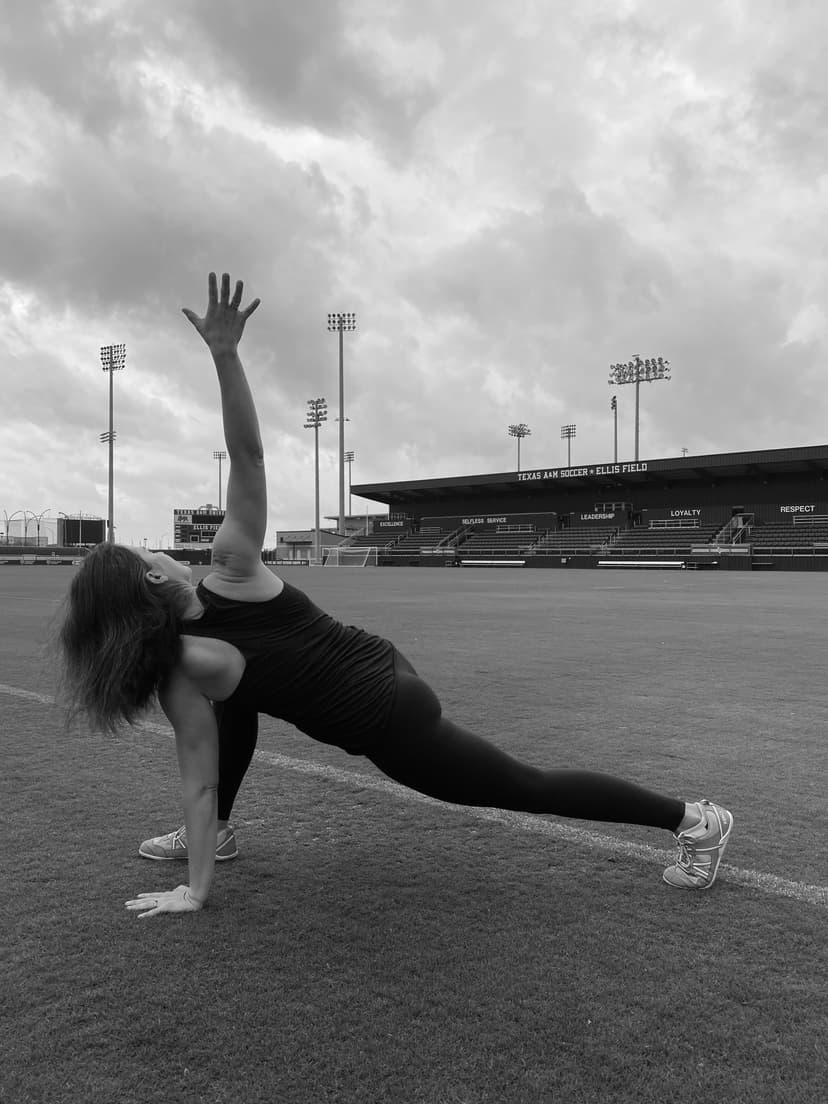
Ellis Field · Texas A&M
Program Outcomes
The Numbers Behind the Protocol
Published research outcomes from peer-reviewed studies on yoga and Pilates as a supplement to competitive athletic training.
+20%
Hamstring & Hip ROM
Collegiate athletes completing a 10-week yoga supplementation program showed significant gains in hamstring and hip range of motion on the sit-and-reach test.
Source: Polsgrove MJ, Bower BM, Blocki RP. Int J Yoga. 2016;9(1):27–34.
−24%
Salivary Cortisol
Athletes in a 6-week yoga group showed significantly lower post-session salivary cortisol compared to an aerobic exercise control, indicating faster parasympathetic recovery.
Source: West J, Otte C, Geher K, Johnson J, Mohr DC. Ann Behav Med. 2004;28(2):114–118.
−22%
Balance Error Score
The same 10-week collegiate yoga study measured proprioceptive balance via BESS testing. The yoga group reduced balance errors significantly vs. the control group.
Source: Polsgrove MJ, Bower BM, Blocki RP. Int J Yoga. 2016;9(1):27–34.

Lead Instructor & Program Designer
Lauren Whitehead, MS Biology · MS Public Health
While completing her Master's degree at Texas A&M, Lauren taught Anatomy labs — developing the rare combination of clinical anatomical knowledge and practical movement instruction that defines the Neon Fox method. Her sessions aren't informed by anatomy. They are built from it.
The Clinical Edge
Three Pillars of the Protocol
Injury Mitigation
Before a hamstring tears, it compensates. Before a labrum tears, it guards. Our movement assessments identify these dysfunctional patterns in their pre-injury state — asymmetries in hip rotation, thoracic restrictions, ankle mobility deficits, and the subtle movement avoidances that precede structural failure.
Lauren's anatomical training means she doesn't just observe movement; she identifies the underlying tissue and joint dynamics that produce it. The result is a proactive intervention model that seeks to identify movement compensations before they lead to injury.
Sport-Specific Sequencing
There is no universal recovery protocol. A football lineman's hip mobility demands are structurally different from a track sprinter's fascial elasticity requirements, and both differ from a baseball pitcher's posterior shoulder mechanics.
Every program is engineered from the sport's specific movement demands — joint angles, velocity profiles, ground contact patterns, and positions of maximum vulnerability. This is not adapted yoga. It is biomechanical programming built for athletes.
Recovery Science
Lauren's Public Health background brings a systemic lens to recovery that most movement coaches don't have. Autonomic nervous system regulation through structured breathwork, and training load periodization are integrated into every protocol.
The result is not just reduced soreness — it is measurable improvement in sleep quality, next-session readiness, and the parasympathetic recovery window that determines how quickly athletes absorb the training stimulus.
Sport-Specific Programming
Built for Your Sport's
Exact Movement Demands
There is no universal recovery protocol. Every program is engineered from the joint angles, velocity profiles, and positions of maximum vulnerability specific to each sport.
Football
Program Focus Areas
- Hip flexor capacity for explosive stance and drive
- Lumbar rotation for rotational power and change of direction
- Adductor integrity for lateral agility patterns
- Fascial decompression after repetitive high-impact ground contact
- Thoracic mobility for quarterbacks and receivers
Baseball & Softball
Program Focus Areas
- Rotational power sequencing from hips through core to shoulder
- Posterior shoulder and rotator cuff integrity for arm care
- Thoracic rotation for batting mechanics and pitch velocity
- Lat engagement and release to reduce UCL load
- Hip mobility for power generation in the kinetic chain
Track & Field
Program Focus Areas
- Hamstring integrity under eccentric loading at sprint velocities
- Fascial elasticity and spring mechanics for distance economy
- Hip flexor capacity for hurdle clearance and stride length
- Achilles and ankle complex for jumpers and explosive events
- IT band and lateral hip protocol for distance injury prevention
Programs also available for Basketball, Volleyball, Tennis, Swimming & Diving, and all TAMU Club Sports. Custom sport assessments on request.
Engagement Models
Three Ways to Work Together
From full-roster seasonal contracts to elite 1-on-1 draft prep — every engagement is custom-scoped for your program's needs.
Team Seasonal Contract
Weekly on-site recovery and mobility sessions woven directly into your existing training block. Pre-season assessment, in-season maintenance, and post-season recovery phases are planned in advance with your S&C staff.
- 4 on-site sessions per month
- Pre-season movement screening
- Sport-specific curriculum
- Monthly performance report to coaching staff
- Coordination with athletic trainer / S&C staff
Elite Prep — 1-on-1
Private concierge coaching for athletes at every level of the competitive ladder—from high school standouts and dedicated amateurs to those preparing for the NFL or Pro Draft. Whether you are navigating post-surgery movement reintegration or seeking elite individual performance optimization, we bring professional-grade recovery and mobility programming directly to your location. Post-surgery clients are encouraged to work alongside their physician or physical therapist.
- 60-min private sessions
- Initial biomechanical consultation
- Custom program built around scout feedback
- Post-surgery movement reintegration
- Measurable ROM and movement quality benchmarks
- Priority scheduling — College Station & Bryan
Club Sports Power-Pack
Purpose-built for TAMU club programs — Rugby, Lacrosse, Soccer, and others. High-efficiency 60-minute group sessions scaled for club rosters, with 4-session minimum blocks that drive real adaptation.
- 60-min group sessions
- Sport-specific movement curriculum
- 4-session minimum block
- Schedule around existing practice calendar
- Club-budget pricing model
Why It Works
The Science of Availability
Three evidence-based protocols form the foundation of every program — designed for athletes, not for wellness consumers.
Functional Range Conditioning
FRC is not stretching. It is the systematic development of strength at end range — building muscular control in the positions where athletes are most vulnerable to injury. Traditional static stretching creates passive flexibility that the nervous system cannot access under load. FRC creates active, neurologically owned range that transfers to sport-specific positions and protects the joint when velocity and force are introduced.
- Active range development vs. passive flexibility
- Neurological ownership of end-range positions
- Direct transfer to sport-specific joint demands
- Progressive loading protocols — not held stretches
Neuromuscular Reset
High-intensity training creates cumulative patterns of neuromuscular fatigue that standard cool-down protocols don't fully address. Protective guarding, altered motor recruitment, and inhibited synergists persist into subsequent training sessions — degrading movement quality and increasing injury risk. A structured reset protocol re-establishes motor control, reduces compensatory patterns, and restores the movement quality that makes training adaptation possible.
- Clears accumulated neuromuscular fatigue patterns
- Restores inhibited motor recruitment sequences
- Reduces protective guarding post-practice
- Improves next-session movement quality baselines
Breath & Inflammatory Regulation
The parasympathetic nervous system is the body's primary anti-inflammatory mechanism — and it is trainable. Structured breathing protocols directly influence autonomic state, cortisol clearance, and systemic inflammatory response. Integrated at the end of a recovery session, breath work measurably improves sleep onset, reduces perceived soreness in the 24-hour post-competition window, and accelerates the anabolic recovery phase that determines adaptation.
- Activates parasympathetic recovery state on-demand
- Accelerates cortisol and inflammation clearance
- Measurable improvement in HRV and sleep quality
- Reduceed perceived soreness in 24-hour window
Coach & Staff Inquiry
Request a Team Audit
Tell us about your program and we'll respond within one business day with a custom proposal and availability for the Brazos Valley area.
Neon Fox provides high-performance recovery in College Station/Bryan and injury prevention services for athletics and club programs. Our mobility & recovery coaching is led by Lauren Whitehead who is 200-Hour Registered Yoga Teacher, Certified Personal Trainer, certified in Pilates and Barre and holds dual Master's degrees in Biology and Public Health. Serving the Brazos Valley since 2023.